

Magic Articles
Card Magic for Beginners: Your First Week of Easy Card Tricks
Sep
Most people who try to learn card magic buy too much, too fast. A mixed kit, then a YouTube playlist that jumps from a double lift to an Elmsley count. They try one trick, the handling falls apart, and the whole pile goes in a drawer.
Five tricks this week is too many. Get a normal deck you can hand to someone, pick one trick you will actually finish learning, and practice until you can show it without staring at your hands the whole time.
This is a performance guide, not a method dump. We do not print secrets on the blog. The products below come with their own instructions.
What to buy
Buy two decks.
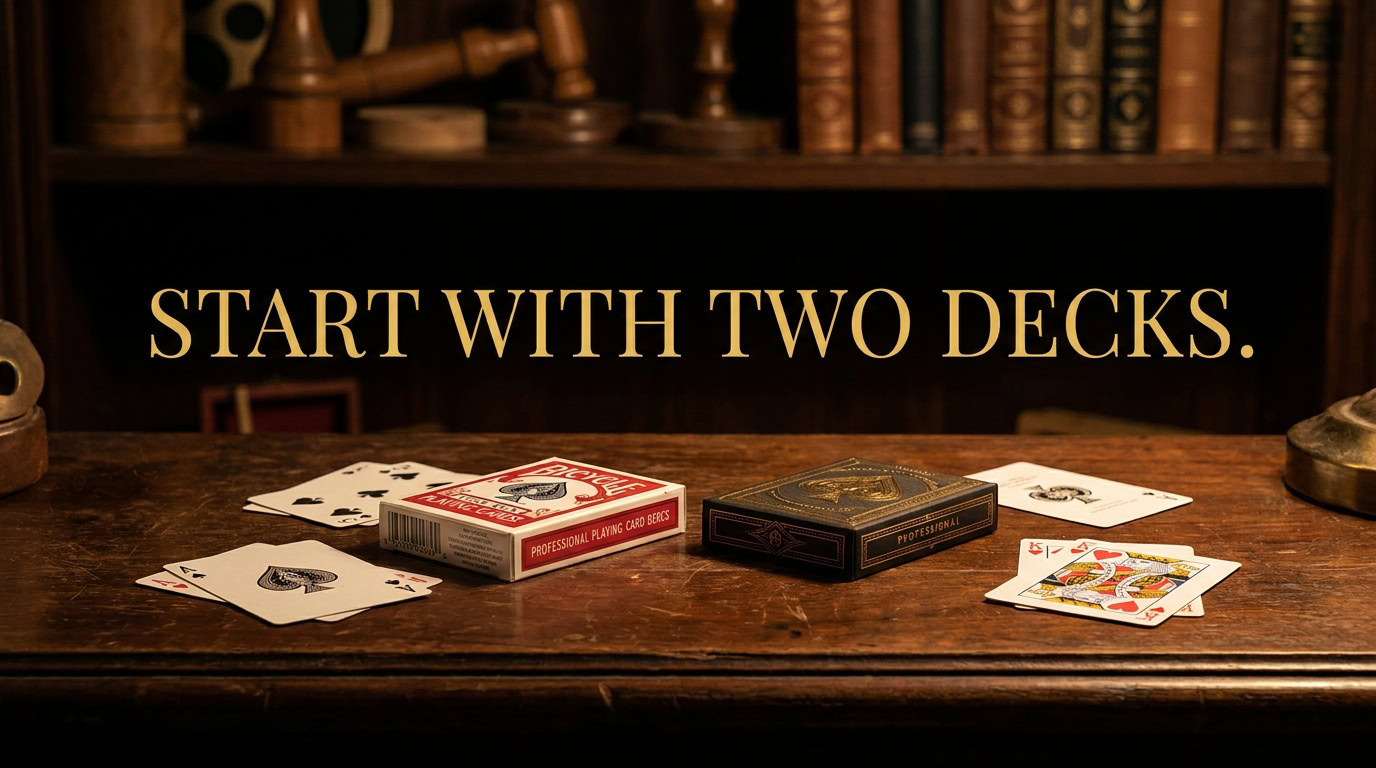
First, a normal pack. Bicycle® Standard Playing Cards are $4.25, red or blue. You want this even if your “real” trick lives in a gimmicked deck. People ask to shuffle. When they do, you should have something ordinary to give them.
Second, one beginner trick deck. For most adults that is either a Svengali Trick Cards – Bicycle Deck ($9.99) or an Invisible Trick Deck of Cards – Bicycle ($9.99). Pick one. The other can wait until you have shown somebody something.
If you want a booklet sitting next to the deck, the Svengali Deck & Trick Book – Learn 100+ Amazing Magic Tricks is $7.99 right now (was $8.99). Those cards are poker size, not Bicycle brand. The Bicycle Svengali handles nicer. The kit is the cheaper way to get printed tricks with it.
The rest of the card section is in Card Trick Magic.
Pick one trick, not five
Invisible Deck: they name a card, it is already reversed
The Invisible Trick Deck of Cards – Bicycle ($9.99, Beginner, ages 10 and up) is built around one picture: someone names any card. You spread the pack. One card is face the other way. It is theirs.
The listing says no sleight of hand is required. That is true, and it still looks weak if you rush. Look at them when they name the card. Then pause for a beat before you spread. The trick is already done; the pause is what makes it feel like a moment instead of a reveal.
There is a demo on the product page if you want to see the effect before you buy. This is the one to start with if you want a single strong trick and you do not need anyone to take a card out of the pack.
Svengali: the card that keeps coming back
The Svengali Trick Cards – Bicycle Deck ($9.99, Beginner, ages 7 and up) is the usual first trick deck because the plot is easy to follow. A card is selected and lost. It keeps turning up. If you want a bigger finish, the faces can appear to change into that one card.
Do not run every Svengali gag in one sitting. Beginners do that, and it turns a good trick into a demo of the prop. Pick one sequence from the instructions and stay on it until you can talk while you do it. If you want more plots later, 101 Tricks with a Svengali Deck Booklet is $3.99 in Magic Books.
Stripper Deck: closer to “I just had a pack on me”
The Stripper Trick Deck of Cards – Bicycle ($10.99, Beginner, ages 8 and up) is the one you can treat more like a regular pack. The listing says the spectator can handle the cards, and that you can use it as a normal deck. Typical effects: a selected card found after a shuffle, four aces at once, a card to pocket.
This is a better everyday deck than the other two, but it is not the easiest first night. Live with a normal Bicycle pack for a few days first so you are not fighting basic handling and a new prop at the same time.
3 Card Monte: a pocket trick, not a whole act
3 Card Monte is $2.99. The shop listing is a packet trick, Bicycle backed: three cards in a fan, an odd card in the middle, and when they pull that card it has gone blank. There is a short demo on the product page.
Keep it in a pocket. It will not replace a deck, and it should not. If you want to see the classic plot, we have an older note on the blog: two easy card tricks, including 3 Card Monte.
Stop Light Cards: two cards, good for a kid
Stop Light Cards – Magic Trick is $4.99, listed as Beginner and self-working, ages 6 and up. Two cards: one with three colored spots, one blank. They name a number from one to three. That color leaves the spotted card and shows up on the blank. The product page says both cards can be handed out after.
If you are teaching a child, start here. If you are an adult who does not want to perform with colored spots, skip it and spend the $4.99 on another Bicycle deck instead.
Optional extra, not week-one homework: Vanishing Deck – Magic Playing Cards Version is $5.75 (was $5.99), listed as No Skill Needed. A full deck goes into a case and the deck is gone. The listing notes the demo video uses a Bicycle pack; the cards you receive are the ones in the photos. Save it until you already have one trick you can show.
Leave sleight of hand for later
If a listing says no sleight of hand required, believe it. Spend this week on the trick in front of you: the order of actions, where you look, and what you say. Mixing in a double lift on night one is how people stall for months.
After you have shown someone a trick, the first sleight worth learning with a regular deck is a double lift. We are not teaching it here. Learn it from a legitimate book or a teacher who is allowed to teach it. Before you start, your overhand shuffle should look like mixing cards, not like a move you are demonstrating. If you cannot shuffle while talking about something else, you are not ready for a double lift.
Forces, an overhand control, and an Elmsley count can wait. They are real tools. They are also how beginners collect six moves and zero audiences.
Card Magic for Beginners: A Real First Week
Most beginners quit not because card magic is hard, but because they start in the wrong order: they learn five tricks before they can handle a deck, or they learn a flashy sleight before they’ve ever fooled anyone with something simple. This guide fixes that order. It’s built around one goal — getting through one complete trick, for one real person, by the end of the week.
Step 1: Get comfortable holding cards before you learn any trick
You don’t need a special deck to start. Any standard deck of playing cards works. Before learning a single trick, spend time just handling cards:
- Shuffle (overhand and riffle) until it feels natural, not like something you’re performing.
- Fan the deck open and closed.
- Deal cards smoothly without fumbling the corners.
- Square up a deck (tap it neatly into a tidy stack) — this small habit instantly makes you look more confident.
This sounds boring, but it matters more than any trick. An audience reads confidence with the object as much as they read the trick itself. If your hands look unsure, even a great trick feels shaky.
Step 2: Understand the two ways card tricks work
Almost every beginner card trick relies on one of two things:
- A gimmicked (trick) deck — the deck itself does most of the work. For example, some trick decks have cards arranged in a repeating long/short or forwards/backwards pattern that lets you control what a spectator seems to “randomly” find, without you doing any sleight of hand. These are genuinely good for beginners because the mechanics are invisible to the audience and forgiving of imperfect handling.
- Sleight of hand with a normal deck — you learn a specific move (like controlling a card to a certain position, or making a spectator’s card appear to be one thing when it’s actually another) that lets you perform “impossible” effects with cards anyone could examine.
Trick decks are the better starting point. They let you focus entirely on presentation — the pacing, eye contact, and timing that actually sells a trick — instead of splitting your attention between remembering a physical move and performing.
Sleight-of-hand starts to matter once you want your “real” deck (the one people shuffle) to be indistinguishable from your trick deck, or once you want more variety than a single gimmick allows. It’s worth learning eventually, just not in week one.
Step 3: Pick ONE trick and learn it properly
The single biggest mistake beginners make is learning five tricks shallowly instead of one trick deeply. A mediocre trick performed with total confidence beats a great trick performed nervously, every time.
Whatever trick you choose, learn it the right way:
- Read or watch the full instructions once, start to finish, before touching the cards.
- Walk through the method slowly with the instructions nearby, focusing only on getting the sequence of actions correct.
- Do it again without looking at the instructions. Slow down anywhere you hesitate.
- Practice saying out loud whatever you’d actually say to a person — magic is a conversation, not a silent demonstration.
- Practice in front of a mirror or record yourself on your phone. You will be amazed at how often you look down at your hands without realizing it — looking at the spectator, not your hands, is one of the most underrated skills in magic.
-
A 7-day plan that’s actually realistic
You need about 10–15 minutes a day, not hours.
Day 1 — Get used to the cards. Shuffle, deal, fan, square the deck. No trick yet. The goal is for cards to stop feeling awkward in your hands.
Day 2 — Learn the sequence. Pick your one trick. Go through the method slowly, instructions in view, until you have the order of steps right.
Day 3 — Drop the instructions. Run the trick from memory. Say your patter (the words you’ll actually use) out loud. If you blank, glance at the instructions and keep going — don’t improvise a “fix” that isn’t part of the actual method.
Day 4 — Perform it once, for one person. A friend, partner, or family member. Just once. Notice what felt shaky — that’s your homework for tomorrow, not a reason to panic or learn something new.
Day 5 — Fix the one weak spot. Almost always it’s one of: rushing the reveal, looking down at the wrong moment, or over-explaining. Drill that specific moment ten times.
Day 6 — Perform it again, ideally for someone new. If it felt solid, you can add a short second trick and perform your stronger one last (always end on your best material). If it still felt shaky, stick with just the one.
Day 7 — Watch, don’t learn. Watch a skilled card magician perform (live, if you can — otherwise a recorded performance, not a tutorial). Pay attention to pacing: how long they let a reaction land before moving on, how little they fidget with the deck between phases. Then just shuffle for ten minutes and stop.
Practical things nobody tells beginners
- Perform where you’ll actually perform. If you’ll be standing at a party, practice standing, not sitting at a desk.
- Slow down the reveal. Beginners rush the moment of magic because they’re nervous it won’t work. A short pause before you show the result is often the entire difference between “cute” and “how did you do that.”
- Have a normal, unexamined deck on hand too, if your main trick uses a gimmicked one. People often ask to shuffle “your cards” — it helps to have an ordinary pack ready so your gimmicked deck never has to be handled by anyone but you.
- Don’t chain tricks back-to-back with the same prop. Doing three effects in a row with the same trick deck starts to look like you’re demonstrating a gadget rather than performing magic. One strong trick, well presented, beats three quick ones.
- It’s fine to be transparent that it’s “a trick.” You don’t need to claim real magic. What people respond to is the moment of not knowing how, not a claim of the supernatural.
A simple cart of magic
You do not need all five. A Bicycle pack plus one trick deck is enough. A Bicycle deck to learn sleight of hand or use it to hand out instead of the trick deck you are using.
- Bicycle® Standard Playing Cards: $4.25. The normal deck.
- Svengali Trick Cards – Bicycle Deck: $9.99. First trick deck for most people.
- Invisible Trick Deck of Cards – Bicycle: $9.99. One strong named-card trick.
- Stop Light Cards – Magic Trick: $4.99. Small, self-working, good for kids.
- 3 Card Monte: $2.99. Pocket packet.
More in the card trick collection. Instruction booklets live in Magic Books.
What to learn after week one
Once you can comfortably perform one trick for a stranger, reasonable next steps, roughly in order of difficulty:
- A second trick with a different gimmick or plot, so you’re not repeating the same type of effect.
- A basic false shuffle or cut with a normal deck — a way of appearing to shuffle without disturbing an order you’ve set up.
- Card control — secretly keeping a chosen card in a known position.
- A basic force — getting a spectator to unknowingly “choose” the card you want, while it feels completely free.
These are worth learning from a proper book or an experienced teacher rather than piecing together video clips, since these techniques rely on subtleties (timing, angles, misdirection) that are easy to learn wrong from a single video and hard to unlearn later.
Dreamland Magic sells performing magic — coins, cards, silks, and stage props — not crystal-ball fantasy. We do not expose methods in this article. If you want material you can actually perform, start with a legitimate dealer copy.