

Magic News
Stealing Magic Documentary (2026): Why Original Tricks Are Under Attack
Aug
A new true-crime documentary is circulating among magicians on X and at film festivals this year — and it is not another “how the trick is done” clip. Stealing Magic follows working creators as they try to stop people who steal original effects and resell them on illicit sites. If you buy magic, book shows, or just love watching a clean vanish, this is the story that explains why original tricks are worth protecting.
What is the Stealing Magic documentary?
Stealing Magic is an 88-minute U.S. feature documentary that had its world premiere in the Spotlight Documentary program at the 2026 Tribeca Festival. It is directed by Matthew Testa and produced by Ethan Smith, Melanie Miller, Diane Becker, and Randy Pitchford. The official festival logline is blunt: someone is stealing the secrets behind magicians’ greatest tricks and selling them on illicit websites, and magician Andi Gladwin leads a team of illusionists on an international hunt for the people doing it. (Tribeca Festival)
The film is in English, Serbian, Arabic, and Czech, with English subtitles. Alongside Gladwin, the billed participants include George Luck, Joshua Jay, and Penn & Teller. (Tribeca, IMDb)
This article does not name pirate sites, recap investigation spoilers, or explain any trick methods. The useful part for visitors is the practical question the film raises: if original magic is this easy to steal, how do you support the people who actually invent it?
Why magicians are talking about it
On X, the current magic conversation is a messy mix of viral performance clips, festival dates — and a lot of expose content. Stealing Magic cuts against that grain. It treats original routines as creative work with a real cost, not as free internet content.
Rolling Stone’s Jason Newman called it “one of the best films of this year’s Tribeca Film Festival,” and compared the tone to “The Bourne Identity as directed by Penn and Teller.” In the same piece, Gladwin says the average creator may only make two or three thousand dollars per trick, and those tricks typically take a good few years to create. George Luck describes an attempted takedown that came back as extortion — a demand of $25,000 a month in bitcoin. Gladwin’s line in the clip is the one working magicians keep quoting: the future of magic is at stake because of piracy. (Rolling Stone)
Magic-industry coverage fills in the timeline. Gladwin had already been telling convention audiences about a years-long effort to confront a notorious piracy operation; cameras covered roughly the last three years of an investigation that Genii reports had been running for eight. Vanishing Inc. colleagues Joshua Jay and George Luck appear as part of that effort. Penn & Teller speak to what it takes to originate an effect — and what happens to the art when creators stop sharing because the work will be stolen. (Genii, Conjurly)
Director Matthew Testa told Genii he came in during the eighth year of the investigation, looking for a true-crime story with levity: magicians as “citizen investigators.” He also said magic is especially vulnerable because it asks so much skill and practice, in a digital world where it is easy to be entertained without doing any of that work. (Genii)
What “stolen magic” actually costs a working magician
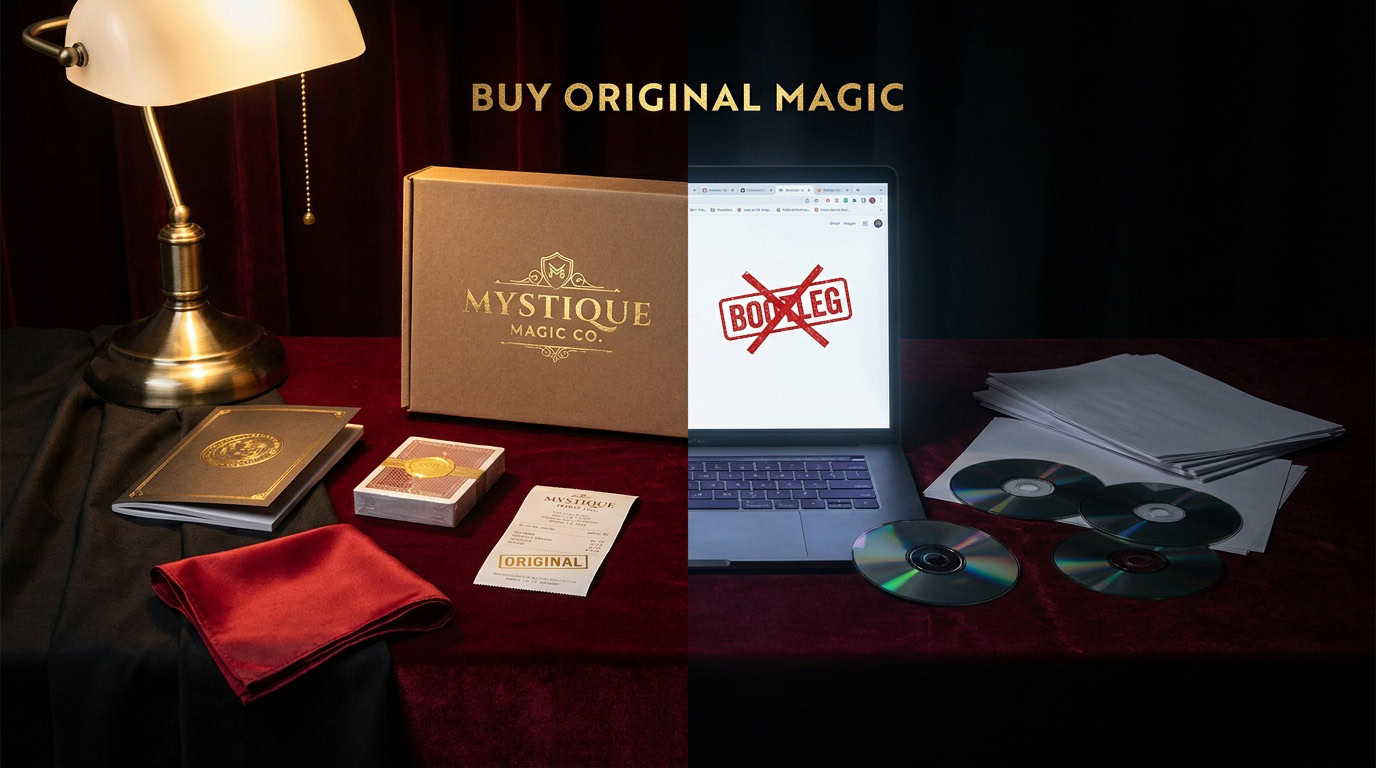
Lay audiences sometimes assume a magic trick is a gag you can copy after one viewing. Professionals know the expensive part is rarely the plastic gimmick. It is the years of thinking, testing, writing instructions, shooting a demo, and building a reputation so other magicians will trust the release.
When a bootleg copy undercuts that release, several things happen at once:
- The inventor loses the only payday. Many effects are not a lifetime royalty stream. They are a small product launch. If the first months are eaten by a pirate listing, there may never be a second effect from that creator.
- The demo lies. Stolen listings often reuse official video. Buyers think they are getting the real handling, then receive a bad clone, a photocopy, or a file with no rights attached.
- The art gets quieter. Teller’s point in coverage of the film is the one that should worry spectators too: when creators stop creating and sharing, audiences see fewer new miracles. (Conjurly)
Genii’s later write-up frames the movie as more than a caper. The question underneath the chase is what obligations magicians have to an art form whose value depends on originality, trust, and respect for other people’s work. (Genii)
None of that requires you to know a method. It only requires you to treat a trick the way you would treat a song, a novel, or a piece of software: buy it from someone who is allowed to sell it.
Where to watch Stealing Magic (as of September 2026)
There is no wide streaming release announced on the official pages we checked. Right now the film is living a festival life:
- Tribeca Festival (New York), June 2026. Four screenings, all sold out, including the June 5 world premiere at Village East by Angelika. (Andi Gladwin, Tribeca)
- DC/DOX (Washington, D.C.), June 12, 2026. DC premiere at the Burke Theatre, U.S. Navy Memorial — also listed as sold out. (DC/DOX)
- MAGIC Live, August 2, 2026. Two screenings at The Orleans Cinemark, sponsored by Genii, for MAGIC Live attendees via account ballot only. (Andi Gladwin)
- Yellow Springs Film Festival, October 1, 2026. Opening-night screening at the Foundry Theater at Antioch College, 8:00 p.m., with Andi Gladwin and David Williamson, plus a Q&A. (Andi Gladwin, Eventbrite)
Fishbowl Films has posted an official scene clip if you want a spoiler-light look at the tone before you hunt down a screening: STEALING MAGIC — Clip 1 on YouTube.
For dates after that, Gladwin’s film page is the cleanest official tracker.
How to support original magic (without being a detective)
You do not need to fly around the world with Gladwin’s crew. If you perform, collect, or shop for gifts, these habits actually move money to inventors:
- Buy from a real dealer, not a random marketplace dump. Authorized shops pay invoices. Random “too cheap to be true” listings often do not. Dreamland Magic is a performing-magic shop — cards, coins, silks, stage props — and we stock creator-made effects, not pirate PDFs.
- Match the demo to the seller. If the video is clearly a manufacturer demo but the listing is a stranger on a classifieds site, walk away.
- Prefer named creators. A release that says who invented it, who manufactures it, and what you actually receive (gimmick, online instructions, booklet) is easier to support and easier to return if something is wrong.
- Do not traffic in “exposed” files. Watching a viral reveal clip is one thing. Paying a stranger for a stolen manuscript is how the next original effect never gets made.
- If you are a creator, document your work. Dated demos, invoices, and dealer agreements are boring until you need them. The film exists because that paperwork suddenly mattered.
If you want to put money on original close-up and parlor material we actually have in stock right now, these are legitimate creator/dealer items — not bootlegs:
- BERMUDA (Vanishing Torn Corner) |Nicholas Lawrence — a named-creator card vanish, in stock.
- Twisted Sisters Card Trick — a modern classic packet trick sold as the real release.
- Vanishing Silk Magic Trick — a physical silk vanish for real-world performing, not a downloaded “secret.”
- Passage Card Trick (Gimmicks and Online Instructions) by Anthony Vasquez — gimmicks plus official instructions from the creator’s release.
Browse more performing props in our magic tricks collection. If a deal looks like a full professional routine for pocket change, it is usually stolen or incomplete.
FAQ
Is Stealing Magic a trick-expose movie?
No. Festival and press coverage describe it as a true-crime investigation into people selling stolen material, not a method dump. We are not recapping secrets here, and you should not expect the film’s job to be “here is how the tricks work.”
Who made Stealing Magic?
Matthew Testa directed. Fishbowl Films is the production company on IMDb. Producers include Ethan Smith, Melanie Miller, Diane Becker, and Randy Pitchford. Gladwin, Luck, Joshua Jay, and Penn & Teller appear. (Tribeca, IMDb)
Can I stream it tonight?
Not from the official pages we checked in early September 2026. The next public-facing date on Gladwin’s site is the Yellow Springs Film Festival opening night on October 1, 2026. Watch that page and the Tribeca film listing for distribution news.
Does buying original magic really matter if I only perform for friends?
Yes. Most magic products are priced for hobbyists and weekend performers, not arena tours. That small legitimate sale is often the entire business model. A bootleg still costs the inventor the same lost copy.
Sources
- Stealing Magic | 2026 Tribeca Festival
- Stealing Magic documentary page — Andi Gladwin
- Stealing Magic (2026) — IMDb
- Stealing Magic — DC/DOX
- Jason Newman, Rolling Stone, June 14, 2026
- Nyla Gilbert, Den of Geek, June 5, 2026
- Vanessa Armstrong, Genii: Stealing Magic: A Documentary
- Conjurly: world premiere announcement
- David Corsaro, Genii: Stealing Magic: Snapshot of an Investigation
- Fishbowl Films, STEALING MAGIC — Clip 1
Dreamland Magic sells performing magic — coins, cards, silks, and stage props — not crystal-ball fantasy. We do not expose methods in this article. If you want original material you can actually perform, start with a legitimate dealer copy.